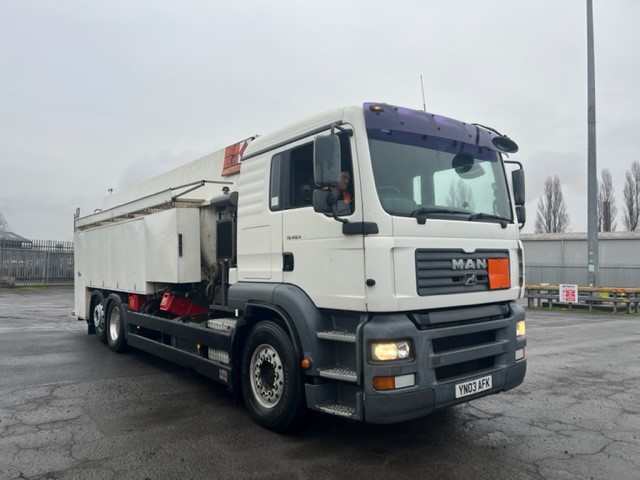
Used MAN TGM Fuel Tanker Trucks for Sale from the UK
German Engineering Built for Petroleum Distribution
Fuel distribution doesn’t reward improvisation. The truck on the route has to load cleanly at the terminal and deliver accurately at the forecourt. It needs to hold its compartment seals all day, then turn up tomorrow ready to do it again. The MAN TGM 26.340 was built for exactly that kind of work, and the units that pass through our yard arrive with the documented service histories you’d expect from UK petroleum operators working under DVSA, ADR and HSE oversight.
We’ve spent more than two decades sourcing commercial vehicles for international buyers. The TGM continues to draw repeat enquiries from petroleum distributors across Africa, the Caribbean and Southeast Asia. The reasons are straightforward. German build quality and a sensible specification for fuel work. Euro 6 compliance from new. And a chassis that handles the awkward weight dynamics of a partly filled multi-compartment tank better than most.
If you’ve been looking for used MAN TGM fuel tanker trucks for sale from the UK, this is one carefully prepared 2017 example. It comes with the documentation and inspection record you’d want before committing to a purchase you can’t see in person.
Current Stock: 2017 MAN TGM 26.340 Fuel Tanker (SJ67 LXH)
Registration: SJ67 LXH. Year: 2017. Mileage at the time of writing: 347,251 km.
This is the last of three identical 2017 to 2018 MAN TGM 26.340 tankers we had on the yard earlier in the year. The other two have already shipped. The remaining truck is in good working condition throughout, with comprehensive service documentation. The previous keeper was a UK petroleum distributor running it under the maintenance regime that licence holders here are required to keep.
Tank, Compartments and Dispensing Equipment
The aluminium barrel holds 20,000 litres across five compartments, configured 5,000 / 2,500 / 5,000 / 2,500 / 5,000. That’s the standard split for multi-product distribution. It lets you run mixed loads of petrol, diesel and other grades on a single route without contamination risk. Dispensing runs through an Emco Wheaton digital metering system, which is the kit most UK fuel operators specify when they have a choice rather than the cheaper alternatives. A front-mounted delivery hose and reel keeps the operator clear of passing traffic during forecourt deliveries. There’s an access ladder beneath the barrel for routine inspection, and bottom loading is fitted, which makes terminal turnaround quick rather than awkward.
Chassis, Drivetrain and Manoeuvrability
The 26-tonne GVW chassis runs a 6×2 rear-steer axle layout, which is the configuration that makes a real difference on this kind of work. Tight forecourts, narrow service station entries and the occasional rural turnaround all become less of a problem with a steered tag axle. Power comes from a 340 BHP MAN engine paired with a manual gearbox. A lot of distributors prefer manual on this kind of work because it gives the driver more direct control on hills, in stop-start traffic and when reversing under load. Real-world fuel consumption tends to sit between 32 and 38 litres per 100 km depending on terrain, traffic and how heavily the truck’s running. Take that as a guide rather than a guarantee.
The chassis itself has the reinforced mounting points that purpose-built tanker work demands. That matters when partly filled compartments are sloshing payload around at junctions and roundabouts.
Cab, Safety and Driver Aids
The cab has a camera system giving proper coverage around the truck. That earns its keep on busy forecourts and in tight depots where blind-spot incidents are an avoidable hazard. There’s a touch-screen radio for long shifts, an external sun-visor, and air conditioning that actually works. That last one sounds obvious until you’ve sat in a tanker cab in 38-degree humidity without it.
Euro 6 emissions compliance comes as standard at this age. That’s worth flagging for buyers in markets where regulators are catching up with European environmental standards. Some operators worry about Euro 6 complexity, but the after-treatment kit on these MAN engines has settled into reliability after years of fleet operation.
Who This Truck Suits
The SJ67 LXH suits petroleum distributors running multi-product routes, bulk fuel suppliers servicing forecourts, and contract hauliers adding tanker capacity to a mixed fleet. Terminal-to-station operations also fit the spec well. Mileage, condition and UK petroleum-fleet history all line up here. It’s a sensible buy for operators wanting a tanker they can put into service as soon as it lands.
What the 26.340 Designation Actually Means
MAN’s naming gives you most of what you need to know. The 26 is the gross vehicle weight in tonnes, and the 340 is the engine output in horsepower. That ratio is what makes the TGM work for fuel distribution. Enough power to keep schedule on hills with a full load, not so much that you’re paying for output you don’t need on flat urban runs.
We’ve watched these trucks operate across very different conditions, from congested city forecourt deliveries in northern Europe to extended rural routes serving smaller communities. The chassis is engineered with liquid cargo dynamics in mind. A tanker handles differently from a rigid box truck, and the difference gets more pronounced as compartments empty during a multi-drop route. MAN’s chassis design accounts for that rather than ignoring it.
What These Trucks Are Used For
Forecourt and Urban Distribution
Most TGMs on this duty spend their working life moving between fuel terminals and retail forecourts. The rear-steer axle is the feature that pays for itself in this work. Access roads to forecourts are tight, and manoeuvring space is rarely generous. The difference between a steered tag axle and a fixed one is the difference between a five-minute drop and a ten-minute argument with the geometry.
Multi-Product Distribution
Five compartments and proper meter calibration make this truck a sensible choice for distributors running mixed-product routes. The Emco Wheaton kit gives you the transaction-level recording commercial customers expect. The compartment splits are the standard configuration for most retail and commercial fuel mixes.
Terminal Operations
Bottom-loading capability matters more than people give it credit for. Terminal dwell time is one of the largest variable costs in fuel distribution. A truck that loads quickly and cleanly extends the daily delivery window, and that adds up across a year of operation.
Rural and Long-Distance Routes
The TGM also works for distributors serving rural communities and remote sites where the round trip is long and the terrain isn’t always cooperative. The 340 BHP output and manual box give the driver options that some automatics still struggle to match on steep, slow gradients with full tanks.
Why UK-Sourced TGMs Make Sense
Three things separate UK-sourced fuel tankers from stock you might find elsewhere. All three are why buyers from regulated markets keep coming back to British fleets.
The first is the maintenance regime. UK petroleum operators work under MOT, ADR and HSE timetables. Those produce a service record you can actually verify, not one assembled the week before the sale. ADR certification on dangerous goods vehicles is taken seriously here, and the records reflect that.
The second is documentation. UK-registered tankers ship with the certificates, manuals and inspection records that overseas customs and operating authorities want to see. Missing paperwork is the most common reason specialist vehicles get held at port, and that risk drops to nearly nothing with UK stock.
Third is the operating environment itself. UK enforcement isn’t lenient. A tanker that’s spent five or seven years passing UK inspections has been kept in a state most fleets globally would be happy to inherit.
Right-Hand Drive: A Practical Point
For markets driving on the left, a UK-sourced RHD truck removes the retraining problem before it starts. Drivers sit on the correct side, sight lines work the way they expect, and the truck operates the way the road system was built for. That sounds obvious until you’ve watched a left-hand-drive tanker try to deliver to a tight UK-style forecourt.
Where We Ship
Africa
South African distributors have been steady buyers of MAN TGM tankers, particularly for routes that mix coastal humidity with highveld altitude. The chassis copes with both. East African markets including Tanzania and Zambia have shown rising demand for European fuel tankers. Build quality and serviceable Euro 6 economy work well for the longer rural routes the geography demands. Zimbabwe and Mozambique are expanding markets where infrastructure investment is creating fresh distribution capacity.
The Caribbean
Jamaica and Guyana are the standout markets in the region. Jamaica’s geography runs from urban Kingston to mountain interior, and a tanker that handles both is worth the import cost. Guyana’s developing road network suits a tanker designed for variable surfaces rather than motorway running alone.
Southeast Asia
Malaysia and Thailand are the steadiest sources of TGM enquiries from the region. Euro 6 compliance lines up with where local emissions regulations are heading, not just where they are now. The rear-steer axle makes urban delivery in dense Southeast Asian traffic considerably less painful than it otherwise would be.
Notes on the Engineering
The chassis design is the unflashy part of the spec sheet that does most of the actual work. Reinforced mounting points handle the cyclical stress of liquid loading and unloading. The frame geometry keeps the truck predictable when compartments are partly filled. That’s the most common operating state on a multi-drop route, not the rarest. The rear-steer axle isn’t a gimmick. It changes what kinds of forecourts and terminals you can actually deliver to without backing manoeuvres that nobody enjoys.
Euro 6 after-treatment is more complex than the older Euro 5 setup. The trade is real-world fuel economy gains in the 8 to 10 per cent range. You also get access to urban zones that exclude older emissions standards. Treat the economy figures as directional rather than fixed.
Pricing and What You Get for the Money
A 2017 MAN TGM 26.340 in this condition typically costs a good deal less than a new equivalent. That gap is the budget you can put into ancillary kit, terminal infrastructure or a second truck, depending on how your operation is structured. MAN parts availability is genuinely global, so residuals hold up better than for less common platforms. A well-maintained TGM has plenty of working life left at this mileage.
Our Export Process
The truck is prepared for export before it leaves the yard, and the relevant documentation packages with the vehicle. We work with shipping partners experienced in specialist commercial loads, so the haulier isn’t learning the job at your expense. Routing, timing and likely costs are something we’ll discuss properly at the enquiry stage rather than after the deposit clears. Once the truck has landed, we’re available if you need us.
Contact Sales
Andy Ward
Andy’s spent decades in the commercial vehicle industry. That includes years inside UK DAF dealer networks across sales, service and parts, plus a period as MAN Brand Director in Saudi Arabia. He’s worked the MAN range from both the dealer side and the manufacturer side, in conditions rather hotter and harder on equipment than anything the UK throws at a truck. If you’ve got configuration questions specific to the TGM, want to talk through whether a 26-tonne rigid is the right fit for your route profile, or need a view on what’s likely to work in your operating environment, Andy’s the person to ask.
Email: an*********@*********co.uk
Phone: +44 (0)7966 986032
WhatsApp: +44 (0)7966 986032
Paul McCord
Paul runs the commercial export desk and is the right call for the wider Clugston International range, stock availability beyond MAN, shipping costs, timings and the practical mechanics of getting a truck out of the UK. He’s handled enough international export transactions to know where deals tend to come unstuck. His background in fleet management means he tends to understand what operators actually need from a truck rather than just what looks good on a spec sheet.
Email: pa*********@*********co.uk
Phone: +44 (0)7712 674 458
WhatsApp: +44 (0)7712 674 458
Clugston International Trading. Brigg Road, Scunthorpe, Lincolnshire, DN16 1BB. Over twenty years exporting specialist commercial vehicles worldwide.
If you’ve been looking for used MAN TGM fuel tanker trucks for sale from the UK, the simplest next step is a phone call. SJ67 LXH is the only one left from this batch, and we’ll either confirm it’s still on the yard or talk through what’s coming through the network next.